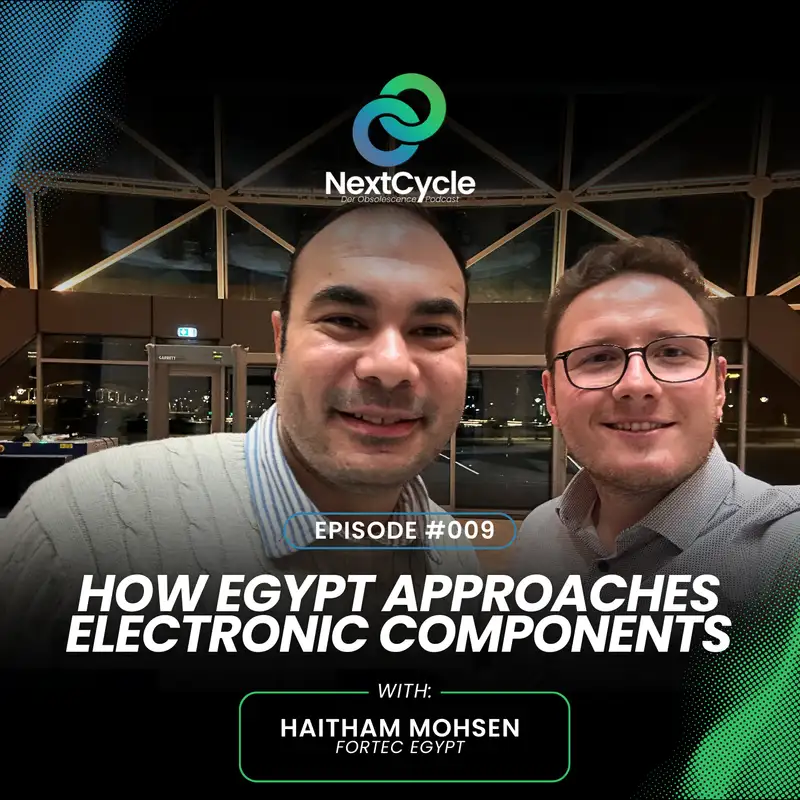
NextCycle #009 – How Egypt Approaches Electronic Components & Supply Chain Challenges
(0:00 - 0:16)
Yeah, hi Haitham, thanks a lot for being here in my podcast NextCycle. Also here we have the first English version, so I'm looking forward for your perspective. Also from, we are here in Egypt, so it's also nice to get a different kind of view, not a European view.
(0:17 - 0:33)
So thanks a lot that you are here and let us start again with your introduction. It's been a pleasure having you here as well and I'm really interested in and really amazed by the kind of data you're sharing on your podcasts. So yeah, happy to be here.
(0:33 - 0:44)
Let me start with a short introduction. My name is Haitham Mohsen. My background is in electronics and communication, did masters as well in wireless communication and information technology.
(0:45 - 1:00)
And lastly, I capitalised on that with an MBA in IE Business School. This is all related to the educational side. I would say my professional background is I've been working for 10 years in a huge mobile operator.
(1:01 - 1:32)
Later, I joined the government, where I've been working on several kinds of projects that are under the presidential initiative. And lastly, I joined Fortec for the last two years, where we are doing this interview right now in the office of Fortec here in the new presidential capital here in Egypt. Let us now switch a bit more in the direction of electronics and supply chain.
(1:33 - 2:25)
How do you describe the electronic industry in Egypt today? I would describe the electronic industry in Egypt right now as it's in the transition period. So what's the transition period? So Egypt used to be a consumer market as a whole, but now we are transitioning to a more of manufacturing market as well. So now the government is pushing for building new factories, improving the infrastructure to help these kinds of supply chains and pushing most of the companies either to manufacture or at least to have an R&D design centre or import, like I have a branch here in Egypt to leverage the kind of opportunities that Egypt is providing.
(2:27 - 3:04)
And also let us have other few, what type of components and also what type of technologies are growing fast in Egypt currently? Type of components and type of technologies that's growing in Egypt. I would have to say that any kind of technology that is related to digitalisation of infrastructure. So basically anything related to digitalisation of the process because the government is pushing for that.
(3:04 - 3:44)
They're trying to connect all the ministries or digitalise all the process. So any kind of technology that's related to this, this is booming right now in Egypt. I would say the second thing would be any kind of IoT or sensor application, because again using this kind, pivoting this kind of digitalising thing in Egypt, Egypt is trying to leverage these kinds of sensors or IoT into its smart grids, either in electricity or natural gas or all these kinds of things.
(3:45 - 3:57)
And that's why this sector is also booming here in Egypt. What else? Any kind of technology related to enhancing the manufacturing here in Egypt. So basically, for example, Fortec fits in here.
(3:57 - 4:39)
So basically all the kind of technology that we are providing like displays or embedded solutions or even power electronics, it's always feeding in, enhancing the quality of factories, enhancing the infrastructure in general, which is really booming here in Egypt. And I think lastly, anything related to the energy sector, because Egypt is trying to modernise its electric grid, leveraging, focussing on projects related to green energy, either with hydrogen energy generation, wind energy or anything related to that, and integrating these kind of the old grid to the new grid. This is the thing also that Egypt is focussing on right now.
(4:41 - 5:31)
What strengths does Egypt have regarding these topics currently? Egypt has a very, let's say, unique positioning regarding this, which is related to its location. So as you know, Egypt is, let's say, in the centre of the world right now, connecting Asia, Africa, even Europe as well. And Egypt is trying to leverage its position to make sure that they try to localise these kinds of manufacturing, and at the same time, share these incentives for foreign investment to set up office here and use this as a pivot for a supply chain security-wise.
(5:31 - 5:54)
So basically, security regarding supply chain, and at the same time, a safe net from kind of tariffs that might be happening due to the geopolitical situation, which Egypt is presented as a benefit or advantage right now. Yeah, it's quite interesting. Let us switch to the supply chain.
(5:54 - 6:32)
What are the biggest sourcing or also in supply chain challenges currently in Egypt? So the problems, basically, facing the supply chain. I would say one of the biggest problems is still having bureaucracy in the import and export process here in Egypt. It's not 100% digitised, which the government is trying to push for right now, where they are trying to remove the bureaucracy by creating industrial free zones or private free zones to help companies flourish and overcome these kinds of problems.
(6:32 - 6:56)
That's one. Two, the second thing I would say is regarding a little bit of bureaucracy in general, and because this kind of bureaucracy, I would say technology gap. Because we don't have manufacturing here, manufacturing facilities that would build like active or passive components.
(6:57 - 7:25)
So usually they are being imported from outside. And I think the direction that the government is going for is trying to localise to overcome the situation. And that's why they are pushing for the first point where I mentioned doing industrial free zones to bring in or make Egypt a very advantageous place to have your factory here so that this will increase the local part of manufacturing.
(7:25 - 7:38)
And this, in general, will solve this kind of problems. In the end, I was also thinking the moment about the big chips shortage we had three, four years ago. Yeah.
(7:38 - 7:50)
And that's also a thing which will help you. I think it will repeat, we do not know when it will repeat, but it will repeat. And when you have a kind of industry also in this field, it will also support you.
(7:51 - 7:53)
Yes. Yeah. Okay.
(7:53 - 8:10)
Then let us switch a bit to the governmental point of view maybe also. How does the government support the electronic industries here in Egypt? Yeah. So the government is actually supporting the industry here in Egypt in, I think, in a multitude of sectors.
(8:10 - 8:37)
First of all, they are trying to give a lot of incentives for companies to come and have their own branches and build up. This is regarding R&D centres and anything like, I would say, fabulous. So they are trying to push for that because leveraging these kinds of young talent is a huge advantage for having such an R&D centre or design in centre.
(8:38 - 9:05)
That's one. The second thing would be in giving incentives for manufacturing as well. So they are trying to do like tax deductions and offer like factories, locations with services and with deductions in prices and stuff like that to incentivise companies to build and start manufacturing here in Egypt.
(9:05 - 9:57)
The last thing I would say is one of the huge initiatives that has been helping is the EME initiative. It's called Egypt Makes Electronics, where the government is actually a presidential initiative under the supervision of the Ministry of Communication and ETIDA, where they are trying to help build the electronic ecosystem here in Egypt, which is focussing on upscaling the already existing young talent to meet the requirements of international companies and at the same time, provide spaces and office spaces for companies to set up shop. And lastly, they are trying their best to remove any kind of bureaucracy that companies might be facing either in import and export by creating programmes like whitelist or train to hire or stuff like that.
(9:58 - 10:55)
When you're looking back, so you were also personally working for ETIDA, when you're focussing on this time, what did you build during this time? Yeah, so what did I build? Actually, I helped build a lot in the time and the time was really rewarding because we have been trying to travel around the world and talk about the benefits. As I mentioned, the young talent pool, the geographical location, the proximity even in the time zones between Egypt and Europe in general, it's actually one hour difference, which is really good when you're trying to do an international team somehow. It's not like seven hour difference or something like this, which is really make the team synergy shine and help with that.
(10:56 - 11:25)
So I tried to, we tried to share this kind of info. So we actually succeeded in bringing in a lot of companies from Europe, specifically generally from all the world. And we have them set up shop in this kind of location, like the one we are setting up here in the Knowledge City, it's called the Knowledge City, where they provide locations for companies, electronic companies to come here and invest and open branches here in Egypt.
(11:25 - 11:54)
This was one. Two, I worked on a project called Train to Hire, where we are actually giving incentives to companies to train the fresh graduates coming out of universities, to let them reach the market, like satisfactory market level that they can just hire them automatically. And once they hire them, it either will reimburse them with the kind of incentives or the money they spend on training.
(11:55 - 12:24)
So it's like just train them and we are going to pay for the training if you're hired. And I think lastly, I tried to work on localising kind of technology here in Egypt, where we did a tender and incentivised or encouraged local companies here in Egypt to manufacture the project locally here in Egypt, instead of importing it from the Far East or something like this. So yeah, these are all things I've been working on.
(12:24 - 12:38)
And I think they all went into the right direction because we are now reaping the rewards of such initiatives as well. Yeah, I can imagine. Yeah, let us now do another perspective switch.
(12:39 - 13:18)
Let us now get more in my field, obsolescence and lifecycle management. So how do Egyptian companies deal with obsolescence today? Actually I would say Egyptian companies are more reactive in dealing with obsolescence. So basically they are doing one of two things, either when they have the capacity or the money and warehouse location to know that they will need a lot of spare parts or something like this.
(13:18 - 14:03)
So they will stockpile all these kinds of parts and keep them on hand and use them to extend the life of the project as much as they can. And the second thing is being reactive, which is once the supplier announces that this is an end-of-life product and you have to choose something else, they would run and see if there is maybe a cheap alternative or non-tested solution that they can get somehow to make things work and push them as far as they can. Or if they couldn't, they would look for a redesign or something like this.
(14:03 - 14:59)
But we are a bit reactive in this kind of situation and that's why the Egyptian market doesn't understand the benefits of having a good understanding of obsolescence and being proactive, not reactive to it. And also then the benefit of proactive is that you are saying, okay, I have here a high-risk part, it's not obsolete, but I'm bringing it out of my design because the risk when it's getting obsolete is too high to get to such points. Maybe also, what do you think, how could strong obsolescence management look in Egypt? Do they use monitoring, for example, that they are watching their bombs, their bill of materials? I think they should do that because I think, to be honest, Germans, this is the kind of thing that they excel at.
(14:59 - 15:39)
And when I say that they excel at this, because usually when they launch a project, they have a long-term plan of covering 10 or 15 years, where they are always checking bombs, checking about the components, are they nearing the end of their life cycle and trying to always be proactive. So they would do redesigns, they would do replacements of other tested components as well to make sure that the product is continuing to its own life cycle that they promised in the beginning. And also bringing alternatives in the early period also into the design.
(15:39 - 15:49)
Yes. Okay. Then let us do another switch, getting more, again, comparison, Egypt versus Europe.
(15:50 - 16:28)
What are the biggest differences between Egypt and German engineering cultures? So yeah, we touched on this before, but let me tell you. So basically the German culture is, as we mentioned, is a bit meticulous, very high on detail, documentation. They have attention to detail that's unmatched, which really results in a product that's going to be resilient, is going to be sustained for a long time, because this is the plan, because they always plan ahead.
(16:29 - 16:53)
And they plan for like, as I mentioned, 10, 15 years, which is the case with the products we have here in Fortec as well. So the products are built to last, basically. On the other hand, the Egyptian culture is more about agility and being frugal and trying to solve problems very fast.
(16:54 - 17:16)
So for example, if there is a problem with a product or a component, Egyptians will try to do a redesign. For example, if a product went into end of life. So the Egyptians would go for, let's try to do a redesign, somehow introduce a different component to fix the situation as fast as possible to meet your customer needs.
(17:16 - 17:35)
This kind of agility is what is needed right now to complement the German culture. So if you are able to combine both, then you got the winning strategy here. Let us do for the last question a switch.
(17:35 - 18:21)
Is there something about obsolescence management you would like to ask me? Obsolescence management? Yeah. How did you, you know about the chip problem that happened like several years ago, how did you think right now the best solution you would do if this problem, as you mentioned, might occur every couple of years or several, like it's bound to happen. So what would you have done now that you think you have missed doing the last time or people should have done back then, but they didn't do and they should change the way of thinking or how they are approaching this problem to be able to move forward? Okay.
(18:21 - 18:45)
Yeah. Let us first start in general with you. It will happen again because it's connected to fear of missing out, so FOMO caught and when such thing, such an event is happening, people not thinking facts and they are then buying like, not stopping to buy, they are buying like somewhere fire or whatever.
(18:46 - 19:14)
And so then it's about emotions and not about facts. So this thing we cannot prevent, but what we can prevent is we can say, okay, we have several alternatives in our design that we maybe have the chance that apart from other supplier who's maybe based in Egypt or more or less in the USA, so that you are there more diversified through all the countries. That's one point what I can imagine.
(19:14 - 19:32)
Then when it's a very critical component, you can use some safety stock that you have maybe one or two years buffer so that when this event is happening that you not have the need to buy directly. You are safe. Yeah, that you can maybe wait how it's developing.
(19:33 - 20:33)
When we are looking, for example, at the thing with an Xperia was not that big boom, but for some weeks we had a kind of similar thing, only focused on one manufacturer, but it will also help you that you have alternatives and also having safety stock and also in general having some money. A lot of companies currently are using a lot of debt, so that is not bad because sometimes you need money to do innovation and to invest, and when you have too much debt, it's getting difficult for you. But because in this situation you are turning, for example, when you are electronic manufacturing service, EMS, and you have the thing that you have missing parts, the rest of the stock for product is in your storage, and then you have the thing you can't sell them anymore to your customers, and the amount of money which is stuck in your storage is increasing.
(20:33 - 21:03)
And in such a period of time, it only helps you to have a bit of money for such a thing, a bit of buffer, that you can solve such issues. So that's also one solution to have a bit of money that it's not a big thing that you have now more money or more of your financial power in your storage. I think that's quite important that you are flexible and agile again.
(21:03 - 21:30)
Definitely agree. So basically you have the cash and the stock to help you save yourself for this kind of... Correct, and you combine it also with proactive obsolescence management, that you have alternatives, and maybe you are lucky and the one manufacturer you have chosen is not covered by the shortage, and would be quite nice. Yeah, of course.
(21:30 - 21:39)
And as you mentioned, diversifying in your supply chain is always the best thing to do. You don't need to be under the... No single source solutions. Yeah.
(21:39 - 21:58)
Always the most important thing. Yes, totally agree with you. Yeah, so Heitan, and thanks a lot also for this talk in next cycle, also for this quite short and brief view on electronics in Egypt, also electronic industry, and also what the government is doing.
(21:59 - 22:01)
Thanks a lot for the pleasure. It's good to talk with you. Yeah.
(22:01 - 22:17)
Thanks a lot. Really, it's been a pleasure having you in Egypt and hope that your perspective about Egypt is a good impression as well. We were lucky to have you and looking forward to having you again, maybe in the near future as well.
(22:17 - 22:32)
Absolutely. I'm also looking in the direction of our viewers, also the ones which are following our podcast, leave a comment, put a like, and we are looking forward regarding your feedback to this episode. Thanks a lot.